

Introduction
Wireless connectivity has become the backbone of modern business operations. From manufacturing facilities and warehouses to healthcare centers and smart cities, organizations depend on stable internet connections to support daily operations, IoT devices, automation, and communication systems.
However, traditional Wi-Fi networks often struggle with coverage limitations, congestion, interference, and security concerns. This is where Private LTE networks are changing the game.
A Private Mobile Hotspots LTE network gives businesses their own dedicated wireless communication system using LTE technology and CBRS spectrum. Unlike public cellular networks, private LTE offers greater control, security, reliability, and scalability.
In this guide, we will explain how Private LTE networks work, their key components, benefits, use cases, and why businesses are rapidly adopting them.
What is a private LTE network?
A Private LTE network is a dedicated cellular network designed specifically for an organization or enterprise. Instead of relying on public carriers, businesses can create their own secure LTE infrastructure.
These networks operate using licensed, shared, or CBRS spectrum and provide reliable wireless broadband connectivity across large indoor or outdoor environments.
Private LTE networks are commonly used in:
- Manufacturing plants
- Warehouses
- Smart cities
- Transportation hubs
- Healthcare facilities
- Schools and campuses
- Rural internet deployments
- Industrial automation systems
Unlike traditional Wi-Fi, Private LTE is designed for enterprise-grade performance and mission-critical operations.
The core components of a private lte network
To understand how Private LTE works, it’s important to understand the major components involved.
LTE Router or Gateway
The LTE router acts as the connection point between devices and the LTE network.
Devices such as the Horizon Powered I282 LTE Router provide:
- SIM-based connectivity
- Secure wireless internet
- Dual-band Wi-Fi
- VoLTE calling support
- LTE CAT 11 speeds
- Failover internet protection
These routers distribute connectivity to multiple devices simultaneously.
CBRS spectrum
In the United States, many Private LTE networks operate using CBRS (Citizens Broadband Radio Service).
CBRS allows businesses to use shared wireless spectrum without needing expensive nationwide licenses.
Benefits include:
- Better coverage
- Reduced interference
- Secure connectivity
- Lower deployment costs
- Dedicated enterprise bandwidth
The FCC officially supports CBRS for enterprise and industrial wireless communication.
External Reference:
- FCC CBRS Overview
- GSMA Private LTE Resources
LTE core network
The LTE core manages authentication, traffic routing, device management, and security.
This component controls:
- User access
- SIM authentication
- Data encryption
- Network prioritization
- Device communication
The core network ensures only authorized devices connect to the private network.
Radios and antennas
Private LTE uses radio units and antennas to transmit signals across facilities.
High-power antennas improve:
- Signal range
- Indoor penetration
- Outdoor coverage
- Reliability in remote areas
This makes Private LTE ideal for large industrial environments where Wi-Fi struggles.
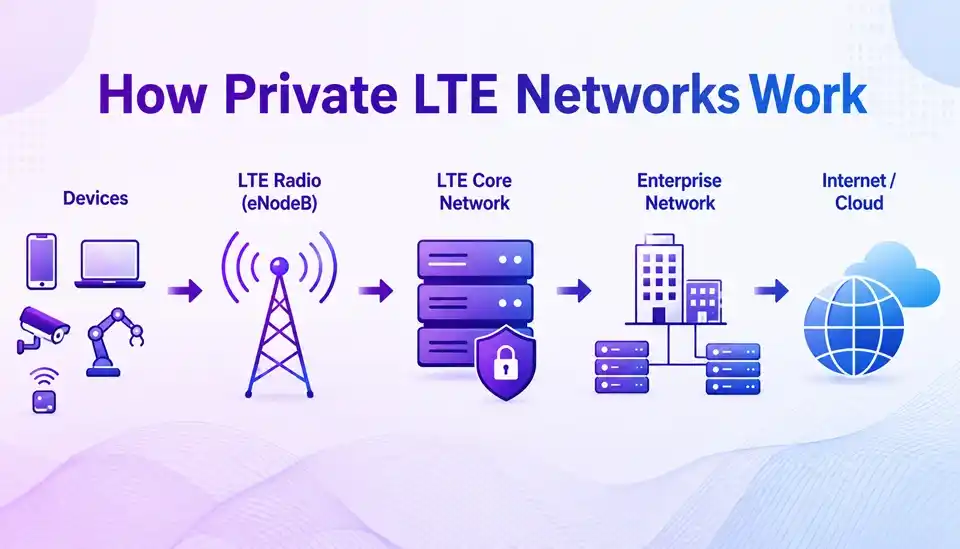
How Private LTE Networks actually work
Here’s a simplified step-by-step explanation.
Step 1: Devices Connect to
LTE Radios
Smartphones, routers, sensors, cameras, and IoT devices connect wirelessly to LTE radios installed around the facility.
Step 2: Data travels through the LTE Core
The LTE core authenticates the device and securely routes traffic through the network.
Step 3: Internet or local communication happens
The network either:
- Connects users to the internet
- Enables local device communication
- Supports industrial automation systems
Step 4: Management platform monitors everything
Administrators can monitor:
- Device activity
- Network performance
- Security alerts
- Usage analytics
Solutions like Horizon DMS simplify remote network management.
Why businesses prefer private LTE Over Wi-Fi
Many enterprises are moving away from traditional Wi-Fi for mission-critical operations.
Better coverage
Wi-Fi access points often struggle in:
- Warehouses
- Factories
- Outdoor sites
- Large campuses
Private LTE provides broader and more stable coverage.
Improved security
Private LTE uses:
- SIM authentication
- Encrypted communication
- Dedicated spectrum
- Firewall protection
This creates a more secure wireless environment.
Lower interference
Wi-Fi networks can become congested in crowded environments.
Private LTE avoids many of these interference issues by operating on dedicated or managed spectrum.
Mobility Support
Devices can move throughout a facility without losing connectivity.
This is especially important for:
- Autonomous vehicles
- Warehouse robots
- Mobile healthcare systems
- Logistics tracking devices
Industries using private LTE networks
Manufacturing
Factories use Private LTE for:
- Robotics
- Automation
- Machine monitoring
- Predictive maintenance
Low latency helps improve operational efficiency.
Warehousing and logistics
Warehouses depend on stable connectivity for:
- Barcode scanners
- Asset tracking
- Smart inventory systems
- Fleet management
Private LTE ensures uninterrupted communication.
Healthcare
Hospitals use secure LTE networks to support:
- Medical devices
- Patient monitoring
- Staff communication
- Secure data transfer
Rural broadband
Private LTE helps deliver internet access to areas with limited wired infrastructure.
Solutions like the Horizon Powered I282 LTE Router provide reliable broadband connectivity using SIM-based LTE networks.
Key benefits of private LTE networks
Reliable connectivity
Private LTE delivers consistent performance even in high-density environments.
Scalability
Businesses can easily expand the network as operations grow.
Secure communications
Dedicated wireless infrastructure improves data privacy and network protection.
Low latency
Real-time applications benefit from faster response times.
Better device management
Centralized platforms simplify monitoring and troubleshooting.
How horizon powered devices support private LTE
Horizon Powered offers CBRS-ready LTE solutions designed for enterprise and industrial environments.
The Horizon Powered I282 LTE Router includes:
- LTE CAT 11 speeds
- Up to 32 connected devices
- Dual-band Wi-Fi
- VoLTE support
- Remote management via TR-069 and DMS
- EWAN failover protection
- Strong external antennas
These features make it ideal for:
- Rural internet
- Small businesses
- Warehouses
- Smart offices
- Remote work environments
Internal Linking Suggestions:
- Link to Horizon Powered I282 Product Page
- Link to CBRS Solutions Page
- Link to “Private LTE vs Wi-Fi” blog
- Link to “Why Enterprises Are Moving Away from Wi-Fi” article
The future of private LTE
As businesses continue adopting IoT, automation, and smart technologies, Private LTE networks will become even more important.
Future trends include:
- Smart factories
- AI-powered operations
- Connected transportation
- Autonomous systems
- Smart city infrastructure
- Private 5G evolution
Organizations want wireless solutions that are secure, scalable, and reliable — and Private LTE provides exactly that.
Conclusion
Private LTE networks are transforming the way businesses connect devices, manage operations, and secure communications.
Unlike traditional Wi-Fi, Private LTE offers:
- Better coverage
- Enhanced security
- Reliable performance
- Low latency
- Enterprise scalability
Whether supporting industrial automation, smart logistics, healthcare systems, or rural broadband, Private LTE is becoming a critical part of modern connectivity infrastructure.
With CBRS-ready solutions like the Horizon Powered I282 LTE Router, businesses can deploy reliable wireless networks built for today’s demanding digital environments.
Ready to improve your business connectivity? Explore Horizon Powered’s LTE and CBRS networking solutions today.
FAQs
Q1. What is a Private LTE network?
A Private LTE network is a dedicated cellular network designed for businesses or organizations to provide secure and reliable wireless connectivity.
Q2. How is Private LTE different from Wi-Fi?
Private LTE offers better coverage, stronger security, lower interference, and improved mobility compared to traditional Wi-Fi networks.
Q3. What is CBRS?
CBRS stands for Citizens Broadband Radio Service, a shared wireless spectrum in the United States used for private LTE and 5G deployments.
Q4. Why do businesses use Private LTE?
Businesses use Private LTE for secure communication, industrial automation, IoT connectivity, and reliable broadband access.
Q5. Can Private LTE work in rural areas?
Yes. Private LTE is commonly used to provide broadband internet access in rural and remote locations.
Q6. What devices are used in Private LTE networks?
Common devices include LTE routers, gateways, IoT sensors, industrial cameras, and CBRS-enabled equipment.
Learn more about How Private LTE Networks Work here.
Related Posts
Mobile Hotspots for Hotels – Reliable Internet Solutions
Best Mobile Hotspot For Road Trip (Cars, RVs, Buses)
Wifi Hotspot For Events (Weddings, Festivals, Fairs)
Best Mobile Hotspots for Trade Shows & Exhibitions
Best Mobile Hotspot for Working Space – Fast & Secure Internet
Why MH07 Is Perfect for Remote Work Travelers and Digital Nomads
Stay Connected Everywhere: How MH07 MiFi Boosts Mobile Internet Access
MH04 vs Public WiFi: Speed and Security Where It Matters the Most
Why MH04 Is Your Ultimate Travel LTE Companion
Why MH500C is Ideal for Seamless Remote Work and Mobile Offices
Mobile Hotspot vs Phone Tethering – Why MH07 is the Way to Go
How MH500C Powers Real-Time Edge Communications
