
Introduction
Energy and mining operations are performed in some of the most demanding environments on the planet. From remote oil rigs battered by salt winds to underground mines where dust and vibration never end, these are not precisely the kind of environments where consumer-grade connectivity hardware survives very long. That’s why USB Dongles for Energy and Mining Environments have become essential. Connectivity in these environments is no longer a nicety—it is critical. Utilities rely on continuous sensing from a distance in order to monitor grid health, mining operations require high-definition video feeds to deliver worker safety, and oil and gas fields require secure networks for supervisory control and data acquisition (SCADA) systems.
Historically, these industries have used heavy-duty enterprise CBRS routers or large LTE gateways in fixed enclosures. But now, a new era of small, high-performance, and ruggedized hardware is transforming the way enterprises approach connectivity: rugged 5G USB dongles. Devices like the Horizon DG505G are specifically designed for harsh field environments and provide the performance of an industrial CBRS LTE/5G router in a package smaller than a pack of chewing gum.
This article delves into how tough USB dongles are transforming communications in energy and mining, why private LTE/5G networks are central to their success, and why the Horizon DG505G is one of the most advanced solutions.
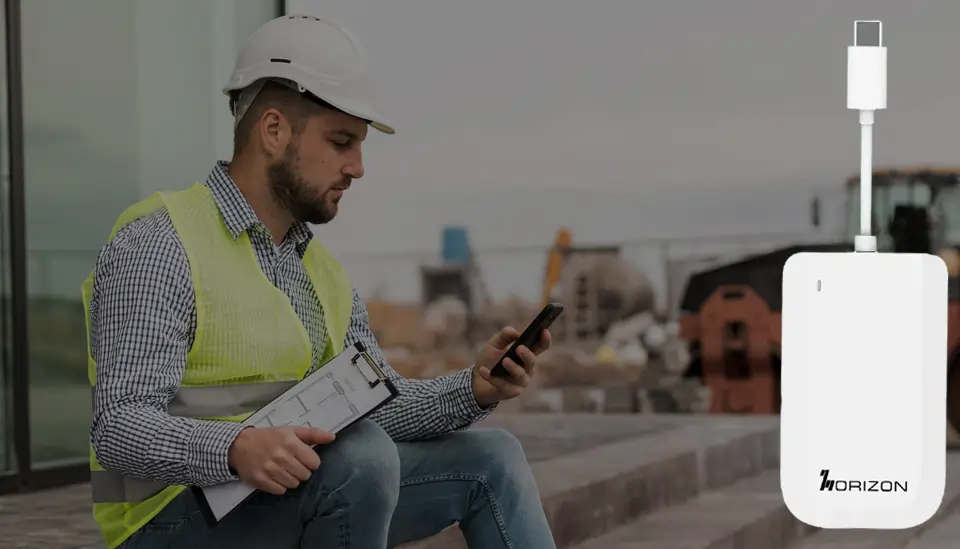
Overview of rugged 5G USB dongles
A USB dongle is usually considered a consumer device—a means by which a student can link a laptop to mobile data whilst on the move. In commercial settings, however, USB dongles are becoming credible, industrial-grade devices. Horizon DG505G, for example, weighs only 42 grams and measures 75 × 45 × 8 millimetres. But packaged inside that slender body is a complete 5G modem with CBRS Band 48, LTE Cat-19 features, and integrated security features.
For the mining and energy industries, it matters since deployment is frequently a mobility and portability issue. A rugged USB 5G dongle is different from big routers in that it can sit comfortably within a field technician’s kit, connect to ruggedized tablets, or provide power to remote IoT usage without the use of additional power packs. By drawing directly from USB-C, it eliminates external adapters and points of failure in hostile environments.
Simply put, it brings enterprise-grade networking in the palm of your hand.
Core technology & performance
The performance leap of rugged dongles is attributed to chipsets like MediaTek’s T750—a 7 nm system-on-chip featuring four ARM Cortex-A55 cores and integrated 5G NR support. It is not a consumer design blown out into industry but an efficiency-, throughput-, and long-service-life-designed solution.
The Horizon DG505G supports:
5G NR bands n1 to n79, both sub-6 GHz and CBRS frequencies.
LTE Cat-19/-20 downlink and Cat-18 uplink, with peak downloads of up to 4.67 Gbps.
Two network modes: the DG505G for private CBRS installations and the DG505G-M variant for SIM-based public networks.
Which means one dongle can plug directly into a private LTE gateway for utility use or be a very capable portable CBRS modem for IoT in-the-field installations.
These rugged dongles can replace larger routers in a broad variety of cases, serving as an extended-range 5G enterprise modem with the rugged simplicity required in energy and mining environments.
Security & manageability
In energy and mining settings, it’s not about speed – it’s about trust. Data transmissions can include confidential information about grid operations, pipeline integrity, or safety controls of mines. That means security is a priority.
Horizon DG505G is an enterprise CBRS device that offers:
Intrusion protection through encryption and a firewall.
WPA/WPA2 wireless protocols and MAC-based access controls.
Remote device management through Horizon DMS, TR-069, and web-based GUI provisioning.
For IT staff supporting hundreds of units in the field, central management enables firmware updates, policy updates, or security patches to be pushed remotely without taking workers away from time-sensitive work. Essentially, these dongles are CBRS smart infrastructure devices, expanding alongside enterprise private 5G networks.
Reliability in rugged environments
Conditions and energy hammer electronics. Heat, vibration, dust, and moisture—every one of them ages hardware faster than office-bound hardware could endure. Hardened 5G USB dongles are made to resist all these.
The DG505G’s small size not only makes it light enough to be carried around but also minimizes the possibility of physical failure. With no external moving components or adapters, it minimizes the number of dust and moisture entry points. Its tri-colour LED indicators provide immediate visibility of connectivity status, which saves field troubleshooting downtime.
Notably, the dongle features CBRS Band 48, a band solely for private LTE/5G deployment in the United States. The band is utilized widely by utilities, oil & gas, and grid infrastructure projects as it allows companies to build their own private 5G networks without being entirely reliant on public carriers.
The outcome? Ultra-reliable connectivity for critical comms, whether it’s checking in on remote wind turbines or enabling underground mine comms.
Use cases in energy & mining
1. Utilities and grid infrastructure
As utilities get digitized, they increasingly depend upon networked meters and sensors across wide geographies. An example of a utility private LTE gateway is the capability for data to travel securely from remote substations back into control centers. Rugged USB dongles like the DG505G plug directly into monitoring laptops or embedded systems to offer real-time access without permanent installations.
2. Oil & gas
Drilling and exploration are likely to occur in locations without reliable terrestrial connectivity. In such locations, the dongle acts as a tough CBRS router for oil & gas, connecting SCADA systems, worker comms tablets, and environmental sensors. With its small form factor, field engineers can carry secure connectivity in their back pockets.
3. Mining operations
Mine needs mobility and reliability. Between open-pit pits and heavy machinery and underground shafts where radio signals are lost, a 5G enterprise modem with long range makes a measurable difference. The dongle’s power to connect rugged tablets carried by safety workers for real-time monitoring of air quality sensors, vehicle tracking, and video communications in extreme underground environments is essential.
4. IoT & Automation
Energy and mining are going automated—remote-operated drilling rigs, for example, and intelligent grid infrastructure. For these use cases, the DG505G is an industrial-strength CBRS modem for IoT with low latency and high-throughput capability needed in mission-critical automation.
Distinct value for enterprise
Compared to traditional LTE routers, rugged USB dongles offer several strategic benefits:
Small size without sacrifice – all the functionality of an industrial CBRS LTE/5G router in a flash drive-sized form factor.
Industry agnostic – equally valuable in utility-grade LTE CPE deployments within the grid as it is as a portable solution in the hands of oilfield engineers.
Scale – as seamless an integration with enterprise private 5G networks as with public LTE.
In-built security – sophisticated protocols enable it to function as a secure enterprise CBRS device on day one.
This ensures rugged USB dongles are more than temporary field solutions, but rather as permanent parts of intelligent industrial networks.
Technical & deployment considerations
When enterprises deploy rugged 5G dongles, they often ask: Will it integrate with existing systems? The Horizon DG505G answers that with broad compatibility. It works across Windows, macOS, Linux, iPadOS, and ChromeOS, ensuring field workers can connect whether they’re carrying rugged laptops or tablets.
Power is a breeze: dongle gets power from USB-C (5 V/3 A), no external adapters necessary. Once plugged in, the device may be configured via the 192.168.1.1 Web UI with a straightforward tri-colour LED indication of connection status.
For IT departments, the introduction of Horizon DMS management and TR-069 allows mass deployments without needing to touch every dongle. That’s priceless for energy companies with geographically dispersed assets or mining operations with multiple shafts dispersed hundreds of kilometres from one another.
FAQs: Rugged 5G USB Dongles for Energy and Mining Environments
Q1. What are the differences between rugged 5G USB dongles and consumer 5G modems
They are designed for industrial-grade use, provide CBRS Band 48 private LTE network support, and feature enhanced security and manageability.
Q2. Can they replace a full CBRS router?
In the majority of field applications, yes. They can be used as an alternative to a rugged enterprise CBRS router, but larger fixed routers may still be used in fixed installations.
Q3. Do they support private and public networks?
Yes. The DG505G is designed for private LTE/5G, and the DG505G-M version has support for SIM-based public networks.
Q4. How secure are rugged 5G USB dongles?
They have encryption, WPA/WPA2 support, firewall protection, and remote policy management.
Q5. Can they handle IoT deployments at scale?
Yes. Being a high-performance CBRS modem for IoT, they are capable of supporting thousands of device connections with low latency.
Q6. Do they work in underground mining environments?
Yes, provided there is sufficient signal coverage. They can be employed to push data from IoT sensors mounted at ground level to surface networks.
Q7. How are they powered?
Through USB-C at 5 V/3 A—no external power supplies are necessary.
Q8. What is the maximum data rate supported?
Up to 4.67 Gbps download speed under optimum conditions.
Q9. Can they be managed remotely?
Yes, via Horizon DMS, TR-069, or web-based GUI.
Q10. Are they suitable for utilities and grid infrastructure?
They are utility private LTE gateways, enabling secure communication among grid assets.
Final thoughts
Energy and mining industries are built upon resiliency. Companies that have to survive in these harsh conditions need a similar type of connectivity hardware. Hardened 5G USB dongles like the Horizon DG505G deliver the best of both worlds: the convenience of a consumer device with the performance, security, and dependability of an industrial CBRS LTE/5G router.
In playing a triple part as a 48 high-reliability router, a utility-grade LTE CPE, and a secure enterprise CBRS device, the DG505G shows how connectivity hardware has come a long way. It is not just a dongle; it is a mobile fortress of connectivity, specifically made for industries where failure is not acceptable.
For energy corporations, miners, and oil & gas companies, deploying rugged USB dongles is no longer an experiment—it’s a strategic step towards a future where secure, high-performance, and resilient networks enable every operation.
Learn more about USB Dongles for Energy and Mining Environments here.
Related Posts
The Ultimate Guide to Choosing the Best 5G Dongle for Tablet
What’s the Difference Between MiFi and 5G USB Dongle?
Everything You Need to Know About 5G Dongles for PC
How Does a Dongle Work?
USB Dongles: A Guide to Their Functions and Applications
Explaining 4G and 5G Mobile Broadband as well as Wi-Fi USB Dongles
Multifaceted Use Cases of 5G USB Dongles
Comparing USB Dongles vs Mobile Hotspots: Which One’s Right for You?
The Rise of 5G USB Dongles: Why DG505G is the Future of On-the-Go Connectivity
Why Modern Enterprises Need Industrial-Grade 5G Dongles