

Introduction
The effect of crises on global education systems
From political crises and natural disasters to pandemics and refugee crises, emergencies disrupt education on a massive scale. UNESCO discovered that during the COVID-19 pandemic, over 1.6 billion learners were affected. School closures, digital divides, and infrastructure deficits caused educators to rethink how learning has to continue. Education Continuity in Crisis with DG505G offers a practical solution, helping maintain education continuity and bridging gaps in access when traditional systems fail.
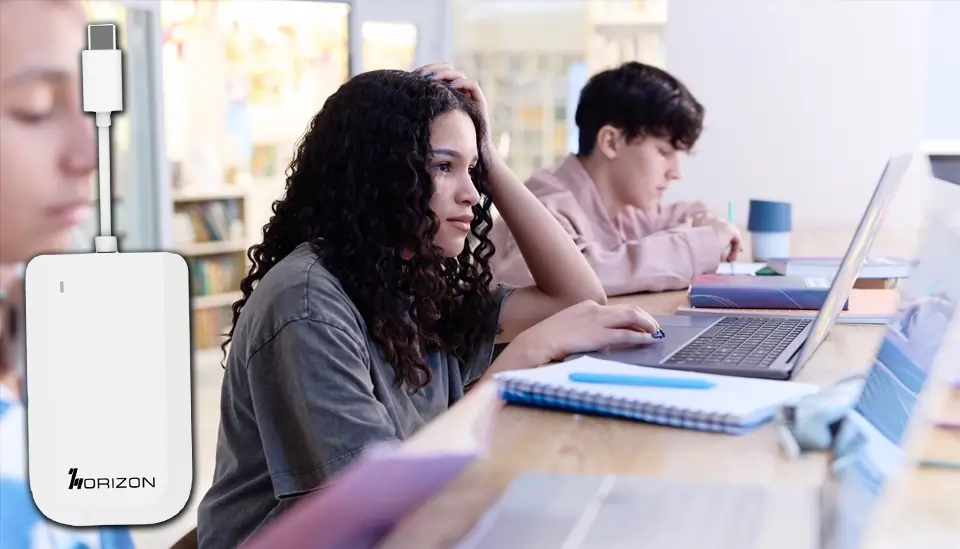
Why digital infrastructure matters in emergencies
During crises, the power to remain connected is the solution to education continuity. Technology provides the means that allow learning, communication, and emotional support to persist. Connectivity can be the weakest link—particularly in disadvantaged communities or conflict zones. That is where small, high-capacity technologies such as the Horizon DG505G 5G USB Dongle step in.
Learning about the DG505G dongle
What Is the horizon DG505G?
The Horizon DG505G is a very portable 5G/LTE CBRS USB-C dongle. It is perfect for emergency deployment in mobile or disconnected environments and comes with no driver requirements, allowing plug-and-play cellular-based internet access.
Critical features for emergency learning environments
- 5G NR and LTE Cat-20 DL / Cat-18 UL support
- CBRS-ready for private network access
- Multi-OS support (Windows, Linux, ChromeOS, iPadOS, MacOS)
- Rugged and compact form factor (74.5 x 44.8 x 7.7mm)
- Global LTE and CBRS band support
- WPA2/WPA3 encrypted connection and VPN support
Challenges that hit education systems amid crisis
Disrupted learning and cut short access
Crisis easily snips off access to school facilities and internet services. The areas remote from cities and combat zones see their students missing weeks or months of formal learning—worsening inequality and long-term academic disadvantage.
Infrastructural shortages in disadvantaged regions
In most areas, especially in Sub-Saharan Africa, Southeast Asia, and rural North America, the Internet is still a luxury. Exorbitant installation fees for fibre or satellite systems ensure that conventional infrastructure cannot be put in place during crises.
How DG505G closes the connectivity gap
5G/LTE access for real-time learning
DG505G connects directly to cellular networks and provides up to 2 Gbps of download speed. Professors and students can then enjoy video conferencing, sharing of files, and interactive classes in real time even whereDSL or fiber is not available.
Supporting synchronous and asynchronous learning
Whether it is live Zoom classes or viewing pre-recorded content on Google Classroom, the DG505G accommodates both models. This kind of versatility is crucial when live teaching is not always an option because of time zones or a power failure.
Timing is everything during a crisis. The DG505G needs no installation, will draw power from any USB-C device, and plugs right in—making it possible for mobile learning centers to go online in a matter of minutes.
Case uses of DG505G in crisis response
Deployment during natural disasters
Natural disasters such as hurricanes, earthquakes, and floods tend to destroy critical infrastructure, cutting communities off from each other and the rest of the world. In such dire situations, effective communication is a lifeline. The DG505G dongle has also become an extremely useful piece of hardware for emergency workers operating in such demanding conditions.
For example, when fixed-line phones and normal internet facilities are destroyed or incapacitated, responders instinctively resort to utilizing DG505G in order to create temporary mobile internet connectivity. Some of the most important uses is their use in mobile classrooms established in the relief camps and shelters. With the availability of Wi-Fi via the DG505G, teachers are able to continue teaching displaced students. Hence, education does not come to a halt, even in times of disruption. The access has enabled students to access learning materials, communicate with teachers, and be as normal as possible whenever there is a crisis.
Remote learning in conflict zones
Conflict zones are one of the most difficult places to provide education. With consistent instability, displaced communities, and poor infrastructure, access to stable Internet is nonexistent. NGOs and humanitarian groups have taken advantage of the ease of use and portability of DG505G dongles to fill this gap. By combining DG505G with educational kits, solar laptops, and Chromebooks, groups have been able to extend digital learning to off-grid settlements and refugee camps. It enables pupils who otherwise would not be able to access classrooms to learn, get access to digital libraries, and interact with instructors and other students. Such a strategy not only promotes continuity in learning but also provides a vital element of stability and optimism in conflict-ravaged regions.
Support in pandemic-era educational models
The world COVID-19 pandemic created an unmatched move towards online learning across the world, revealing system inconsistencies in access to the Internet. Most families, especially those based in rural or underprivileged urban settings, were left without stable broadband connections. In an attempt to rectify this, various schools and community organizations proceeded and employed DG505G dongles as a low-cost and easy alternative.
By sending such dongles to non-fixed internet houses, educators did not leave broadband desert students behind. This opened up space for students to be in virtual classrooms, upload assignments, and interact with peers and teachers. Except for pandemic one-time relief endeavours, these implementations have demonstrated how DG505G can be a round-the-clock product in fostering digital equity and closing learning connectivity gaps.
Perks of DG505G in crisis learning scenarios
Mobility and dependability for mobile classrooms
At its 41g weight, DG505G is convenient to store, carry, and distribute. Its tough casing safeguards against the environment to provide ruggedness in extreme or unstable settings.
Multi-device connectivity and performance
The dongle has the ability to provide bandwidth-hungry applications with the energy they require and allow Wi-Fi tethering from connected devices, enabling small classes of students to use a single connection in class.
Cross-platform and os compatibility
The DG505G works seamlessly on a broad spectrum of gear—laptops, tablets, smartboards, and so forth—so there it is to use with all the hardware mobile learning units have.
Securing and privatizing networks in unreliable environments
CBRS band support and secure LTE
DG505G supports CBRS (Citizens Broadband Radio Service) and allows for private LTE networks perfect for education continuity during times when public networks are unavailable or untrustworthy.
Encryption and VPN integration for privacy
The gear is WPA3 compliant and accommodates all leading VPN providers, protecting student information, protecting learning environments, and complying with privacy mandates such as FERPA and GDPR.
5G-Powered real-time teacher-student interaction
Video lessons, virtual classrooms, and online testing
5G facilitates low-latency video and real-time collaboration. Educators can provide lessons, administer quizzes, and offer real-time commentary, all through virtual channels—peripheral areas included.
Sharing assignments and educational content
They can upload assignments, download files, and engage in forums or peer groups—all sustained by DG505G’s reliable upload and download speeds.
Strong education systems with DG505G
Integrating with governmentand NGO initiatives
Government departments and humanitarian agencies can deploy DG505G in scalable emergency education packs—perfect for national disaster relief or long-term relief initiatives.
Data-driven learning via cloud solutions
By providing access to cloud-hosted learning management systems (LMS), DG505G allows educators to monitor progress, customize content, and leverage data insights to inform improved outcomes—no matter what learning environments are compromised.
Affordable, scalable solutions for education in emergencies
Low infrastructure costs vs. Satellite or fiber
Legacy network solutions such as fiber or satellite need a lot of infrastructure, authorization, and deployment time—completely impossible for emergency or mobile deployments. The DG505G, on the other hand, can be installed straight away with little setup, cutting time and cost investment in half.
Fast deployment for bulk deployments
Due to its plug-and-play function, hundreds of DG505G devices are packaged out by region, school, or refugee camp and plugged in within a few hours. This is a key function for governments or aid organizations aiming to restore access to learning for large numbers of people.
Frequently asked questions about DG505G for crisis education
Q1. Can DG505G support entire classrooms?.
Although intended for single or small group utilization, DG505G may be used in classrooms when shared using Wi-Fi-sharing applications or with a host machine. It accommodates high-bandwidth applications like video streaming and file sharing for 5–10 users based on use category.
Q2.Is it safe enough for students to use in field deployments?
Yes. DG505G prioritizes safety above all else. It’s safe to international standards and offers encrypted connections that provide for both physical protection (low heat, low radiation) and data protection.
Q3. How long will the setup take?
Setup is under one minute. Plug in a USB-C port, let it detect networks automatically, and you’re online—no drivers or installation needed.
Q4. What SIMs or networks do I need?
DG505G is non-locked SIM card and eSIM service supported, and it is compatible with massive global networks along with CBRS bands for private LTE. This makes it simple to deploy in public or private networks.
Q5. Is it power-free?
Although DG505G is plugged into the device from which it draws power, it does draw power from a powered host (laptop, tablet, etc.). Nevertheless, it can be powered by solar-powered laptops or battery banks that are popularly used in mobile and off-grid installations.
Q6. Is it compatible with educational Chromebooks or tablets?
Yes. ChromeOS and iPadOS, in addition to regular Android and Windows tablets, support DG505G. What this means is that it is compatible with the vast majority of educational hardware now deployed in schooling and training institutions.
Final thoughts
DG505G as a lifeline for education continuity during crisis
A crisis can shut down schools and relocate students, but it needn’t have to shatter learning. The Horizon DG505G enables teachers, NGOs, and governments to keep learning whole—be it in disaster areas, refugee camps, or pandemic lockdowns.
Its small-size factor, cross-platform capability, bulletproof security, and lightning-fast connectivity make it a key participant in the world’s effort to deliver equitable, resilient, and unbroken education.
With the DG505G in their hand, studying never has to stop when the world does.
Learn more Education Continuity in Crisis with DG505G here.
Related Posts
The Ultimate Guide to Choosing the Best 5G Dongle for Tablet
What’s the Difference Between MiFi and 5G USB Dongle?
Everything You Need to Know About 5G Dongles for PC
How Does a Dongle Work?
USB Dongles: A Guide to Their Functions and Applications
Explaining 4G and 5G Mobile Broadband as well as Wi-Fi USB Dongles
Multifaceted Use Cases of 5G USB Dongles
Comparing USB Dongles vs Mobile Hotspots: Which One’s Right for You?
The Rise of 5G USB Dongles: Why DG505G is the Future of On-the-Go Connectivity
Why Modern Enterprises Need Industrial-Grade 5G Dongles