

As the world moves towards more renewable energy, solar farms and wind farms are increasing—and so is their importance. For operators, real-time Solar and Wind Asset Monitoring with 5G Dongles is no longer a nicety but an absolute requirement. Downtime, less-than-optimal performance, and delay in fault detection can amount to millions of dollars lost in energy and maintenance. That makes choosing the right communications hardware essential. Enter robust, high-performance devices designed for industrial, utility, and grid-scale use—such as private LTE/CBRS / 5G dongles, rugged enterprise routers, and utility-grade modems.
In this article, we’ll explore how real-time monitoring of solar and wind assets works, the communications challenges involved, and how devices like the Horizon DG505G USB-C dongle enable reliable, secure, and high-throughput connectivity.
Why Real-Time monitoring matters
- Maximization of energy output: Soiling, mechanical degradation, misalignment, or environmental degradation adversely affects solar modules and wind turbines. Real-time sensor measurements (irradiance, wind speed, temperature, voltage, current) facilitate early fault detection.
- Preventive maintenance: Unplanned failure or inefficiency (e.g., blade breakage or panel hotspots) is more expensive than scheduled maintenance.
- Safety of operation: Under severe weather, lighting, or grid conditions, early warning is required to avoid damage or shut-down.
- Grid reporting & compliance: Utilities have to comply with regulatory performance or safety standards; real-time data assists in complying and gaining confidence.
- Remote site issues: Solar/wind assets are mostly situated in remote, hostile sites with poor infrastructure. Strong network connectivity is difficult but necessary.
Communications challenges in solar & wind monitoring
| Challenge | Why it’s Hard | Key Requirements |
| Remote & harsh locations | Sites are often in deserts, mountains, offshore; electrical storms, temperature extremes, and limited power/internet backbone access. | Rugged hardware, low-power consumption, wide band support, and remote manageability. |
| Latency & throughput | Data includes time-series telemetry, SCADA signals, sometimes real-time video (for inspection/drones), weather sensors. Delays hurt diagnostics or emergency response. | High throughput, low latency, reliable connectivity. |
| Security | Grid or utility infrastructure is a critical network. Attack surface must be minimized. | Encryption, secure protocols, private network capability. |
| Spectrum & regulation | Licensed bands are expensive; unlicensed have limitations; private LTE / CBRS bands (e.g. Band 48 in the U.S.) offer advantageous trade-offs. | Support for CBRS / private LTE / 5G NR bands, flexibility. |
| Ease of deployment & management | Deploying fiber or wired links is expensive. Local technicians may have limited training. | Plug & play, simple provisioning, remote device management, ruggedness. |
5G, CBRS & Private LTE: The backbone for industrial monitoring
- CBRS (Citizens Broadband Radio Service) in the U.S. (Band 48 etc.) provides shared spectrum, but with the prospect of using it privately and being managed. Ideal for utilities, remote locations, oil & gas.
- Private LTE / 5G NR networks enable the owner/operator to own or control their network, less dependent on carriers.
- 5G NR Sub-6GHz gives great data rates and good propagation, ideal for far-off or blocked locations.
- Hardened LTE routers and long-range enterprise modems provide field sensor or substation-to-central SCADA / cloud connectivity.
Horizon DG505G USB-C dongle introduced
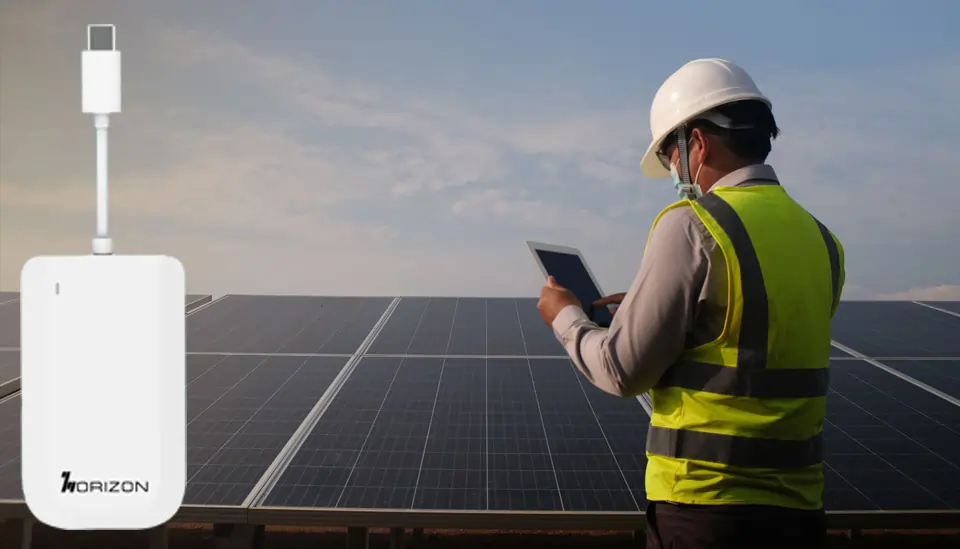
The Horizon DG505G USB Dongle is an high-capacity CBRS / LTE / 5G (USB Type-C) solution ideal for connectivity in demanding environments.
- Based on MediaTek T750 chipset, a power-efficient 7nm design with enhanced 5G radio and LTE performance.
- Covered by CBRS Band 48 (LTE) and 5G NR (bands n41, n48, n78) and LTE bands B41, B48.
- Small (42 grams), low-power, and mobile—perfect for remote field deployment.
- Plug-and-play with Windows, Linux, macOS, ChromeOS, and iPadOS.
- Remote management through Horizon DMS (Device Management System) with Web GUI, usage tracking, and troubleshooting.
- Encryption and security protocols for mission-critical communications at enterprise levels.
Variants
- DG505G: Dedicated LTE network designed on CBRS basis—suited for utilities, as well as managed deployments.
- DG505G-M: Public SIM-enabled LTE/5G network compatible—decentralized or carrier-covered sites appropriate.
How Real-Time monitoring works with DG505G
- Sensor / Edge Data Acquisition: Turbine performance information and solar panels are transmitted to local controllers.
- Edge Gateway / Hub: Bunches data, identifies anomalies, and prepares for transfer.
- Communication Link: DG505G connects to controllers or embedded PCs through USB-C, and offers secure 5G/CBRS connectivity.
- Remote Management: Horizon DMS tracks device health, executes updates, and enforces encryption.
- Data Analytics & Alerts: Data is sent to SCADA/cloud systems, offering predictive maintenance and real-time alarms.
Advantages of using DG505G for solar & wind
| Benefit | What It Means |
| Industrial CBRS LTE/5G performance in compact form | Enterprise-level connectivity without bulky hardware. |
| High-performance CBRS modem for IoT | Handles frequent telemetry and heavier diagnostic loads. |
| Low latency, high reliability | Faster alarms and smoother remote operations. |
| Advanced security protocols | Protects critical utility infrastructure from cyber threats. |
| Private LTE gateway for utilities | Operators maintain network control without carrier dependence. |
| Flexible deployment | Works for temporary, remote, or harsh environments. |
| Long-distance coverage | Effective across wide solar farms and wind installations. |
Use cases: Real-world applications
- Remote Solar Farms: Private LTE CBRS network with dongles by array.
- Wind Turbine Monitoring: Enforces vibration, thermal, and video data uplinks in offshore/onshore turbines.
- Grid Infrastructure / Substations: Offers redundancy to mission-critical comms.
- Oil & Gas + Renewables: Manages mixed environments that need rugged and secure connectivity.
When to use dongles vs Rugged routers
| Device | Best For | Considerations |
| DG505G Dongle | Portable, cost-effective, plug-and-play deployments. | Needs host device, less rugged casing. |
| Rugged CBRS Router | Permanent sites with multiple I/O and harsh conditions. | Higher cost, more power draw. |
| Utility-Grade LTE CPE | Grid infrastructure with advanced routing and multiservice support. | Complex setup, less portable. |
Deployment best practices
- Employ enclosures and stable power sources for dongles in hostile environments.
- Design antenna placement carefully for CBRS / 5G coverage.
- Encrypt traffic and perform firmware updates on a regular basis.
- Filter data from the edge to cause high-priority alarms to override others.
- Buffer local data in the event of occasional outages.
- Utilize Horizon DMS for remote monitoring and updating.
FAQs
Q1. Will a USB-C 5G dongle such as the DG505G actually substitute a rugged CBRS router?
It is use-dependent. For short or low-use monitoring, the dongle will do. For industrial, permanent usage, use it in combination with a rugged enterprise CBRS router.
Q2. Does the DG505G support CBRS Band 48?
Yes, it is also compatible with Band 48 and even optimized for private LTE deployments, making it suitable for utilities and mission-critical communications.
Q3. How secure is data transmission using this dongle?
The device uses top-level encryption and is remotely manageable using Horizon DMS to provide end-to-end security of the data.
Q4. What operating systems does it support?
It supports Windows, Linux, macOS, ChromeOS, and iPadOS.
Q5. Does the DG505G enable real-time video streaming of wind turbine inspections?
Yes. Its 5G modem has the capability to drive bandwidth-hungry apps like video, provided that network conditions are good.
Q6. Is the dongle ruggedized for deployment outside?
The device is small and light but not completely ruggedized. In extreme outdoor usage, it must be housed in a protective case.
Q7. How does it assist utilities with uptime?
By delivering assured connectivity of vital alarms, telemetry, and SCADA signals, it enables instant response to faults or anomalies.
Q8. How are DG505G and DG505G-M different?
DG505G is suitable for CBRS/private LTE, whereas DG505G-M is compatible with public carrier SIMs on LTE/5G networks.
Q9. Is the device remotely manageable?
Yes, Horizon DMS offers web-based remote management, usage monitoring, and troubleshooting features.
Q10. How does it differ when satellite connectivity is used for remote sites?
Where satellite provides global coverage, it is higher latency. CBRS/5G dongles such as DG505G are lower latency and greater throughput where spectrum is rich.
Final thoughts
Real-time monitoring of solar and wind monitoring devices is the backbone of renewable energy operations. Secure, robust, and reliable communications are the basis on which the monitoring is supported. The Horizon DG505G USB-C dongle provides a compact but robust solution with CBRS/5G/LTE support, remote device management, and robust security mechanisms.
For operators of utility, renewable, and critical infrastructure, this type of utility-grade LTE CPE, safe enterprise CBRS device, and extended-range 5G enterprise modem has the potential to revolutionize operation—converting monitoring from reactive to proactive, providing efficiency, safety, and grid reliability.
Learn more about Solar and Wind Asset Monitoring with 5G Dongles here.
Related Posts
The Ultimate Guide to Choosing the Best 5G Dongle for Tablet
What’s the Difference Between MiFi and 5G USB Dongle?
Everything You Need to Know About 5G Dongles for PC
How Does a Dongle Work?
USB Dongles: A Guide to Their Functions and Applications
Explaining 4G and 5G Mobile Broadband as well as Wi-Fi USB Dongles
Multifaceted Use Cases of 5G USB Dongles
Comparing USB Dongles vs Mobile Hotspots: Which One’s Right for You?
The Rise of 5G USB Dongles: Why DG505G is the Future of On-the-Go Connectivity
Why Modern Enterprises Need Industrial-Grade 5G Dongles
