

Each mile a utility service truck travels is filled with responsibility. Whether it’s a lineman putting back power after a storm, a field crew returning for a gas line check, or a water works crew responding to a failed pump, every move depends on prompt communication. Utility Service Vehicles Stay Connected with DG505G, ensuring they are not mere transit—they’re rolling operations centres where life-and-death decisions are being made and carried out in the trenches. Connectedness isn’t a nicety anymore—it’s the basis for safe, efficient, and prudent operations.
But too many utilities still have problems with lost signals, saturated public networks, or equipment that can’t keep up with the data-intensive workloads of today. In a world where field crews work in real-time with cloud apps, IoT sensors, and encrypted communication pathways, even momentary outages are devastating. Enter the Horizon DG505G USB Dongle—a small yet mighty industrial CBRS LTE/5G router that is poised to disrupt the industry for maintaining service fleets connected wherever the journey takes them.
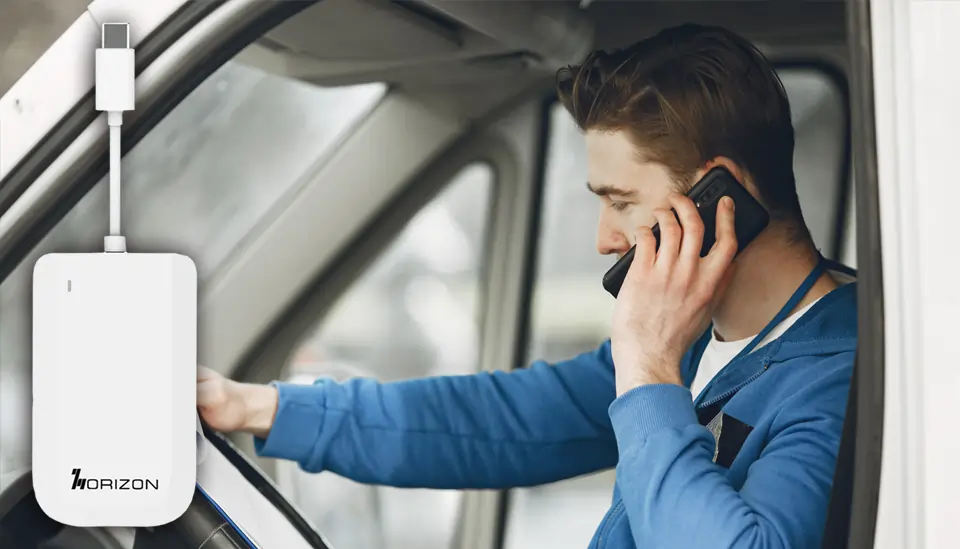
The vital role of connectivity in utility operations
Utility vehicles are more than a transportation method—rolling command and control. Field personnel require instant access to mapping, work orders, SCADA alarms, IoT sensors, and even live video streams from time to time.
- Downtime expenses: Reconnection time is longer when disconnection happens, safety is interrupted, and customer trust is lost.
- Employee mobility: Employees are typically stationed in distant or hostile environments where conventional commercial LTE coverage is intermittent.
- Regulatory pressure: Compliance and reporting require immediate digital accounts.
Connectivity is, in a sense, the lifeblood of the new utilities. Without it, operational performance comes apart.
DG505G: Strong utility-grade connectivity in a small package
The DG505G is not cumbersome or huge. It’s a plug-and-play USB device that performs with utility-grade reliability. Field workers can just plug it into laptops, tablets, or even vehicle-mounted equipment and immediately empower 5G private network gear on the job.
Its tiny size houses the advanced technology inside. Enabling CBRS Band 48, enterprise-grade advanced security features, and high-speed LTE/5G data throughput, the DG505G is a bridge between assets and next-generation utility digital spines.
Key technical advantage of utility vehicles
CBRS Band 48 Support
- Enables utilities to use their own private LTE gateways or 5G private networks.
- Decreases dependence on overloaded public carriers.
- Ensures greater reliability for mission-critical communications.
High-Speed Data Throughput
- Supports bandwidth-consuming applications like GIS mapping, real-time telemetry, and HD video streams.
- Enables IoT endpoints without compromising speed.
USB-Powered Simplicity
- No power source required.
- Simpler integration with field hardware and laptops.
Next-Generation Security Protocols
- End-to-end encryption of utility-sensitive information.
- Offers compliance with energy and water cybersecurity regulations.
Private LTE & 5G enabling for utility vehicles
Throughout North America, utilities are adopting private LTE and 5G networks to transform their infrastructure. With the CBRS spectrum, the capability of companies to support their own secure enterprise CBRS devices, independent of public network constraints, is made possible.
For vehicles, that translates to:
- Always-on, in-zone connectivity within grid infrastructure zones.
- Faster, more robust communications between field personnel and control centres.
- Savings through less reliance on carrier subscriptions.
The DG505G facilitates rapid fleet installation onto such networks, as a field-deployable, extensible smart infrastructure CBRS device.
Rugged reliability in harsh field conditions
Utility workers aren’t working under the best conditions. They’re in storms, deserts, mountains, and all other places in between. The DG505G is designed to endure those realities:
- Cold or hot climate region temperature range tolerance.
- Vehicle movement and vibration tolerance for mobility.
- Robust uptime even for extended duty cycles.
It is not a modem—it’s an electric, oil & gas, and water utility high-funnel CBRS router with mission-critical communications requirements.
Utility vehicle use case scenarios
1. Electric grid crews
When storm-outages take down power lines or transformers, restoration teams require more than radios—they require real-time connectivity to GIS mapping, SCADA networks, and outage management systems. These technologies automatically guide field crews to the location of the fault and enable them to configure intricate field repair operations in real time. The DG505G provides a constant connection to dispatch and control centers even during high-traffic or disaster zones where commercial networks would be bogged down. This enables faster power restoration, improved safety in operation, and improved communication between all crew members.
2. Water utility fleets
Water supply networks must be checked regularly. Field maintenance staff deployed to deal with burst pipelines, faulty pumps, or water quality problems must be able to detect a problem in a short timeframe to minimize service downtime and prevent hazards to the environment. By turning a vehicle into an LTE mobile gateway for mission-critical communications, the DG505G provides field operators with remote access to cloud-based monitoring systems, sends diagnostic data back to headquarters, and sends messages to other teams in real time. It minimizes downtime, enhances response quality, and maximizes water quality compliance.
3. Gas & oil field vehicles
Oil and gas field crews often operate in remote rural areas where public LTE/5G coverage does not exist or is limited. In such high-risk terrain, crew safety and business continuity rely on robust, extended-range connectivity. The DG505G provides the ruggedness of an extended-range 5G enterprise modem, offering crews safe access to digital inspection history, remote monitoring, and emergency comms lines. This not only improves crew safety but also enables operators to more closely comply with strict industry regulation and environmental standards.
4. Emergency response units
During natural catastrophes, including hurricanes, flooding, or forest fires, public cellular networks typically become unavailable because of overloading or destruction. During the emergency response units, such a loss of connectivity will hinder coordination and prolong work that is life-saving. With the deployment of DG505G, agencies have private LTE networks that continue to operate when commercial networks fail. These vehicles become roaming command centres with real-time video streaming, situational awareness dashboards, and direct communications between responders and control centres.
DG505G vs. Legacy utility communication options
Traditional radios
- Tight bandwidth, voice-centric.
- Not scalable for cloud and IoT workloads.
Commercial LTE/5G networks
- Congestion during peak demand.
- Intermittent coverage in rural or disaster zones.
DG505G with CBRS
- Utility-grade performance, secure, private.
- Deployment flexibility fleet-wide.
- Future-proof as utilities transition to edge computing and smart grids.
Working with utility IT & OT systems
The DG505G has some company. It works well with IT and OT utility systems that utilities depend on:
- SCADA systems for grid management.
- GIS mapping for field engineers to work with.
- IoT sensor devices along pipeline and substation paths.
- Cloud-based asset management for predictive maintenance.
Ultimately, the DG505G helps utilities build resilient, future-ready communication strategies that align with the energy transition and smart city growth.
FAQs: How utility service vehicles stay connected with DG505G
Q1. Is the DG505G supported on normal utility laptops and tablets?
The USB dongle is plug-and-play and supports most enterprise-grade laptops and tablets.
Q2. Why is CBRS different from legacy LTE?
CBRS enables businesses to run their own private LTE gateways, which are more reliable, secure, and less dependent on public networks.
Q3. Is the DG505G suitable for tough field environments?
Yes, it is designed to handle tough field environments, such as high and low temperatures, shock, and prolonged hours of usage.
Q4. Is the DG505G limited to utility vehicles?
No, it’s suitable for oil & gas, logistics fleets, public safety, and other vertical industries that require secure mobile connectivity.
Q5. How secure is the DG505G?
It has improved security with end-to-end encryption, under which sensitive utility data is secured.
Q6. Can it work where there is no 5G coverage?
Yes, the dongle is fully LTE-compatible, with a built-in fallback system.
Q7. How does it connect to SCADA systems?
With its locked-down data channels, the dongle can send alarms and real-time telemetry directly into SCADA consoles.
Q8. What is the benefit of a USB-powered design?
Field personnel just plug it in once to devices without requiring additional power sources, making it perfect for mobile crews.
Q9. Is long-distance connectivity supported?
Yes, as a 5G enterprise modem designed for long-distance deployment, it’s designed for maximum range over longer distances in urban and rural settings.
Q10. How does it compare with a standard-size in-car router?
Although larger routers provide more ports and capabilities, the DG505G provides flexible, portable connectivity well-suited to single field devices or light deployment.
11. Can deployments expand over time by utilities?
Yes, it can start small and grow incrementally as private LTE networks mature in service territories.
12. Is it suitable for disaster recovery?
Yes. It is an effective backup when the public networks do not work, keeping rescue vehicles online.
Final thoughts
Utility vehicles are not so much wheels on the road as they are moving foundations of the grid itself, charged with powering, serving, and defending communities. Their capacity to restore, observe, and respond in real time hinges upon a seamless connection. Without it, response times are glacial, data is delayed, and faith in operations erodes.
The paradigm is shattered by the DG505G. By delivering secure, enterprise-class CBRS-enabled devices to service fleets, utilities have a communication platform they can trust. All field crews—line technicians and pipeline inspectors alike—stay connected to mission-critical applications—whether work location is downtown or in the bush.
Small in footprint but robust in capability, the. Whether lineman is restoring power after a storm, field crew is probing a gas line, or water utility crew is out repairing a broken pump, every move is based on minute-to-minute communication. These are not transports—they are command vehicles where decisions are made and implemented out in the field. To be connected is no longer an extravagance—it’s the key to safe, efficient, and solid operations.
But the majority of utilities still struggle with dropped signals, congested public networks, or equipment that can’t keep up with today’s high-data load work. In a time when field forces are working with real-time data, cloud applications, IoT sensors, and secure comm channels, even momentary loss of connectivity can be disastrous. Get to know the Horizon DG505G USB Dongle—a compact yet powerful industrial CBRS LTE/5G router that will be a game-changer for service fleets remaining connected wherever the road takes them.
Learn more about Service Vehicles Stay Connected with DG505G here.
Related Posts
The Ultimate Guide to Choosing the Best 5G Dongle for Tablet
What’s the Difference Between MiFi and 5G USB Dongle?
Everything You Need to Know About 5G Dongles for PC
How Does a Dongle Work?
USB Dongles: A Guide to Their Functions and Applications
Explaining 4G and 5G Mobile Broadband as well as Wi-Fi USB Dongles
Multifaceted Use Cases of 5G USB Dongles
Comparing USB Dongles vs Mobile Hotspots: Which One’s Right for You?
The Rise of 5G USB Dongles: Why DG505G is the Future of On-the-Go Connectivity
Why Modern Enterprises Need Industrial-Grade 5G Dongles
