
Environmental and wildlife tracking have entered a new era. From rainforests so thick they filter sunlight to vast deserts and coastal wetlands, conservation today depends on real-time data collected via sensors, cameras, and GPS-tagged trackers. However, disseminating such data over far-flung and infrastructure-poor regions is a massive connectivity challenge. That’s where 5G USB Dongles for Wildlife and Environment, like the industrial-grade Horizon Powered DG505G, bridge this gap.
Designed to weather unforgiving field conditions and operate across private LTE/5G networks like CBRS Band 48, the DG505G is an enduring mobile connectivity link for environmental IoT sensors. Its rugged dimensions and sophisticated capabilities bridge the gap between frontier ecosystems and digital infrastructure—to enable researchers, NGOs, and government agencies to undertake effective, real-time management of the environment and wildlife conservation.
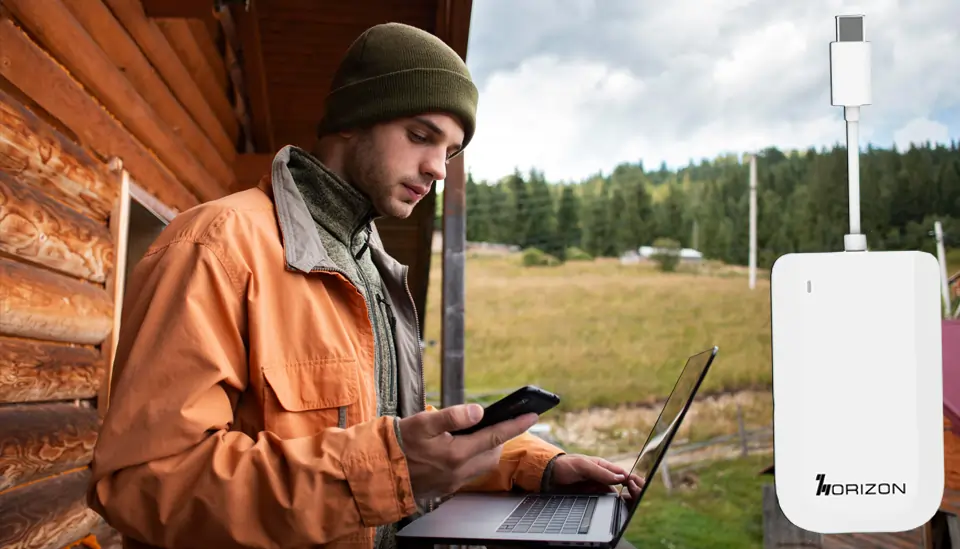
The connectivity gap in the environment
In remote regions of high biodiversity, traditional network coverage is weakest. Environmental and wildlife monitoring initiatives often face an assortment of connectivity issues:
- No cellular infrastructure: National parks and protected areas often feature no commercial towers.
- Harsh conditions: Severe weather, dust, humidity, and rough handling are standard.
- Sparse power sources: Solar-powered or battery-driven systems require low-power solutions.
- Data security needs: Sensitive research and geolocation data require encrypted transmission.
To address these needs, more organizations are turning to private LTE and 5G networks, especially by leveraging CBRS (Citizens Broadband Radio Service) in Band 48. These networks offer secure, scalable, and flexible communications — and USB dongles such as the DG505G as the ultimate gateway to get field devices and sensors onto the networks.
Get to know the DG505G: A durable usb dongle built for the wild.
The DG505G is an unassuming USB modem in outward appearance. However, under its hood, it is built with some of the harshest outdoor conditions in mind.
Key Features:
- Private LTE/5G deployment support through CBRS Band 48
- Robust performance through industrial-grade Qualcomm chipset
- Dual SIM operation with network fallback support
- Stringent security protocols for data integrity and protection
- Fluctuation-resistant casing for field deployment in variable climates
- Plug-and-play connectivity for easy pairing with IoT sensors, edge devices, and mobile field equipment
It operates as a long-range 5G business modem, offering a guaranteed connection even in areas with no traditional coverage.
Environmental use cases: Where the DG505G makes a difference
1. Wildlife Tracking in Protected Areas
Endangered species like snow leopards, elephants, or mountain gorillas are typically tracked using GPS collars. Without a dependable, long-range communication channel, however, all this knowledge is trapped in the device.
With the DG505G integrated into tracking locations or mobile field vehicles, wildlife conservationists can broadcast real-time location data over CBRS-enabled private LTE/5G networks. This enables:
- Remote population monitoring
- Analysis of migration patterns
- Anti-poaching alerts and immediate intervention
Being a smart infrastructure CBRS device, the DG505G allows teams to set up mobile research stations within minutes.
2. Air and water quality monitoring in delicate environments
Environmental sensors installed along rivers, lakes, or industrial sites need to give instant feedback on pollutants, pH, temperature, or turbidity. These systems are usually off-grid and powered by solar panels.
The DG505G, a utility-grade private LTE gateway, can connect these sensors to cloud platforms even in remote locations. Utility-grade LTE CPE certification means it is best suited for regulatory monitoring, early warning, and compliance reporting for:
- Wetlands and estuaries
- Agricultural runoff zones
- Urban-industrial peripheries
Sensitive environmental data is secured end-to-end with its advanced security procedures.
3. Early wildfire detection in forest zones
One of the fastest-growing uses of environmental IoT is early fire detection using heat sensors and air quality monitoring. These systems rely on low-latency communication to enable rapid response.
Plugged on solar-tower or drone-based installations, the DG505G is an IoT high-performance CBRS modem that integrates real-time sensor data to central control dashboards. It ensures:
- Continuous monitoring, even in more remote regions that are more susceptible to fire
- Real-time data transfer to fighting teams
- Interoperability with satellite- or UAV-based systems
The DG505G is a ruggedized enterprise CBRS router that is heat- and dust-proof—essential for high-risk fire environments.
4. Intelligent surveillance to end poaching
CBRS-based camera traps and drones are increasingly applied to detect and deter illegal poaching and logging in national parks. Such systems need an enterprise CBRS device to transmit motion-activated video and GPS location.
The DG505G offers:
- instant photo and video uploads
- Park ranger notifications via control centers
- End-to-end over-the-air encryption from remote trail cams
Since it can operate with CBRS infrastructure, it reduces satellite comms dependence, which is slower and more costly.
________________________________________
Why 5G USB dongles are the future of field connectivity
Fixed routers and satellite terminals are still viable options, but 5G USB dongles like the DG505G provide unique advantages:
- Mobility: Small enough to fit in a field kit, backpack, or even on a drone payload.
- Lightning-fast deployment: Instant network access without tedious setup or alignment.
- Minimum cost: Cost-effective relative to deploying cellular infrastructure.
- Edge suitability: Compliant with modern edge platforms for on-site AI and analytics.
- CBRS support: Compliant with shared spectrum and private LTE/5G cores for low latency and secure links.
For environmental agencies, universities, and NGOs, it means having the option to deploy high-end monitoring solutions anywhere—affordably and with speed.
The DG505G advantage: Built for mission-critical iot in the wild
Let’s break down how the DG505G checks all the boxes for use in environmental and wildlife applications:
Feature Benefit for Environmental Projects
Band 48 & CBRS support Seamless integration with private 5G networks in remote zones.
Tough construction Survives field use in deserts, forests, and mountains
Secure architecture Protects sensitive ecological data with advanced encryption
Plug-and-play USB interface Instantly connects to laptops, edge boxes, drones, or sensor hubs
Power-efficient design Ideal for solar-powered, low-energy deployments
Dual SIM fallback Maintains uptime across multiple networks
Whether a temporary research camp or permanent sensor network in a hotspot of biodiversity, the DG505G delivers enterprise-class, CBRS-based connectivity in an ultra-sleek form factor.
Building a greener, smarter future with CBRS and 5G
Private LTE/5G network installations with the aid of CBRS are increasingly being undertaken by governments and NGOs. With these networks integrated with modular technology like the DG505G, they’re revolutionizing how we gather and act on environmental intelligence.
Key long-term benefits are:
- Less environmental disruption from fixed hardware
- More access to environmental data by local people
- Environmental intelligence from self-monitoring and artificial intelligence
- Cost-effective systems that grow with conservation efforts
With secure CBRS enterprise devices that are perfectly compatible with field platforms, businesses can focus on conservation, not debugging connectivity problems.
FAQs: 5G USB dongles for wildlife and environment monitoring projects
Q1. Is it possible to use the DG505G for solar-powered sensor systems?
Yes. The DG505G is incredibly power-efficient, so it is ideal for inclusion in off-grid, solar-powered environmental monitoring systems in remote areas.
Q2. Why is the DG505G ideal for remote field deployments?
Its durable design, Band 48 support, tiny USB footprint, and stable performance on CBRS networks make it function well in hostile and infrastructure-heavy environments.
Q3. Does the DG505G support private LTE and 5G networks?
Yes. It’s designed specifically to support CBRS (Band 48) for private LTE/5G connectivity, which is ideal for research teams, NGOs, and industrial use in places where there is no commercial coverage.
Q4. How secure is the DG505G for sending sensitive data?
The DG505G has augmented LTE/5G security features such as SIM-based authentication and data encryption to ensure safe and dependable communication for critical environmental and industrial applications.
Q5. What kind of devices can the DG505G connect?
Any host equipment with a USB interface — laptops, drones, edge processors, mobile gateways, camera systems, and sensor control devices — may connect to a 5G/CBRS network through the DG505G.
Q6. Does it withstand extreme weather or abusive treatment?
Yes. The DG505G is built to be durable enough for outdoor field deployments in extreme heat, dust, humidity, or mobile scenarios exposed to drops, shocks, or vibration.
Q7. What is the coverage range using a CBRS network?
With appropriate deployed CBRS infrastructure (such as small cells or mobile towers), the DG505G is capable of operating for several kilometres — enabling long-distance 5G enterprise modem requirements.
Q8. Does it support concurrent use with dual SIM cards?
Yes. The DG505G has dual SIM capability, allowing it to switch between carriers or default to a secondary network, providing maximum uptime even in volatile situations.
Q9. Is this USB dongle suitable for mission-critical communication applications?
Absolutely. It serves as an LTE gateway for mission-critical comms, ideal for field crews that need reliable voice, video, and data transmission in sensitive operations such as wildfire detection or poaching alerts.
Q10. In what way is the DG505G different from traditional LTE modems?
Legacy modems can lack support for private networks, security customization, or field-grade ruggedness. The DG505G is, however, an industrial CBRS LTE/5G USB router—optimized for edge IoT, mobile app, and mission-critical reliability.
Final thoughts
Whether for wildlife protection or environmental monitoring, real-time connectivity is increasingly becoming central to safeguarding the environment. The Horizon Powered DG505G enables a new class of mobile, cost-effective, and secure environmental IoT deployments.
Its rugged build, CBRS capability, and plug-and-play connectivity make it a must-have for researchers, conservationists, and utility operators on the frontlines of ecological data collection.
As the world makes its way towards more effective and technologically advanced conservation, 5G USB dongles like the DG505G will serve as a basis for scalable, decentralized, and intelligent environmental infrastructure.
Learn more 5G USB Dongles for Wildlife and Environment here.
Related Posts
The Ultimate Guide to Choosing the Best 5G Dongle for Tablet
What’s the Difference Between MiFi and 5G USB Dongle?
Everything You Need to Know About 5G Dongles for PC
How Does a Dongle Work?
USB Dongles: A Guide to Their Functions and Applications
Explaining 4G and 5G Mobile Broadband as well as Wi-Fi USB Dongles
Multifaceted Use Cases of 5G USB Dongles
Comparing USB Dongles vs Mobile Hotspots: Which One’s Right for You?
The Rise of 5G USB Dongles: Why DG505G is the Future of On-the-Go Connectivity
Why Modern Enterprises Need Industrial-Grade 5G Dongles