
Introduction: The new campus face of security
Campuses today are confronted with a challenging mix of demands: protecting students and staff, covering large areas with multiple buildings, and integrating digital-first. CC1005G for Comprehensive Campus Monitoring addresses these challenges where old cameras, based on wire-based infrastructure or intermittent Wi-Fi coverage, typically lack the scope, reliability, and real-time reaction needed.
Private 5G networks in place of CBRS rewrites the math. By combining 5G speed, reach, and reliability with the agility of CBRS spectrum (in this case, Band 48 in the U.S.), organizations are able to build secure, carrier-grade monitoring networks separate from outside carriers.
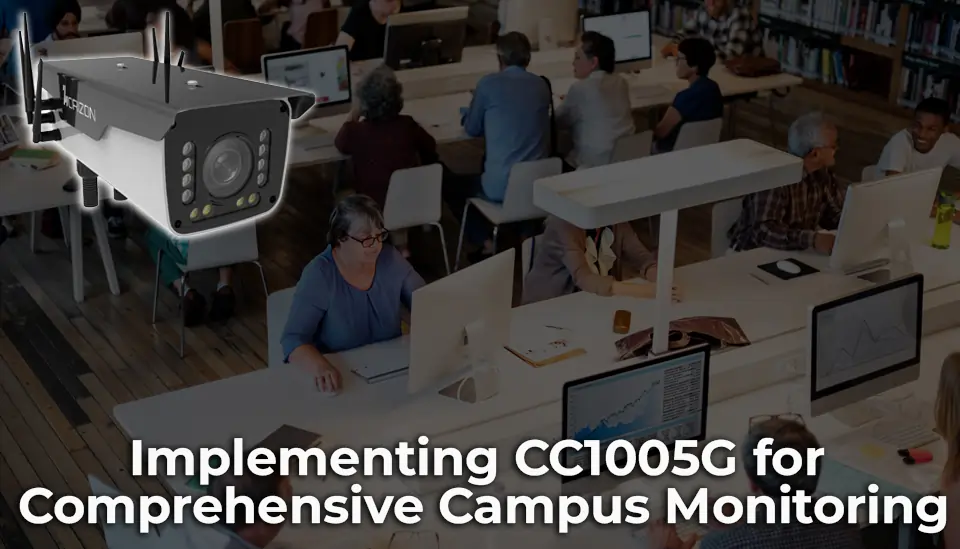
The Horizon CC1005G 5G Camera arrives in this field as a 5G CBRS gateway and access device expressly for the purpose, the equipment for complete campus surveillance. It is more than a router—it is an off-the-shelf gateway for Band 48 networks and a fixed CBRS access device for enterprise-grade security deployment.
This piece examines how campuses can deploy the CC1005G, the technical benefits it offers, and the wider role of private 5G in creating smarter, safer, more efficient learning spaces.
Why private 5G and CBRS are the future of campus security
As a prelude to examining the CC1005G in detail, it’s first worth understanding why enterprise 5G private network terminals are being taken up so quickly in education and enterprise security:
Dedicated, Carrier-grade performance
A private 5G network based on Band 48, unlike public LTE or Wi-Fi, provides dedicated bandwidth and stable performance for security-critical applications.
Extending coverage over large areas
Campuses cover more than a few buildings, open areas, sports facilities, and dorms. Wi-Fi requires extensive AP deployment and suffers from interference. Private 5G can extend seamless coverage across an entire estate.
Ultra-low latency
Video surveillance is not just about recording—it’s real-time decision-making. 5G provides smooth, lag-free video streams even when dozens, hundreds, or even thousands of devices stream simultaneously.
Security and compliance
A CBRS backbone router keeps proprietary video data inside the institution’s private core network. It reduces public internet exposure and makes it easier to comply with strict data policies.
Unpacking the Horizon CC1005G
The Horizon CC1005G is not a consumer device. It is an enterprise edge device for CBRS deployments—the kind of hardware that acts as the gateway between IoT endpoints (e.g., cameras, sensors, and alarms) and the private LTE/5G core.
Key points are:
Band 48 compatibility
It’s fully compatible with CBRS spectrum and ideal for U.S. campuses deploying private LTE/5G.
High-Performance 5G modem
Acts as a private LTE core 5G modem that can handle several high-definition video streams simultaneously.
Edge computing support
Works as an edge computing LTE gateway, supporting near-real-time processing of data at the local level for analytics like object detection, license plate recognition, or crowd counting.
Carrier-Grade build
In a carrier-grade CBRS gateway router architecture, it offers scalability at reliability—either for a small campus or expansive multi-site organization.
Flexible deployment
As a Band 48 network plug-in gateway, it simplifies the installation with reduced dependency on complex fiber backbones.
How CC1005G Enables comprehensive campus monitoring
Now let us explore how campuses can leverage the CC1005G for real-world monitoring:
Seamless video surveillance integration
Campus security relies on scores of cameras spread out among buildings, parking lots, sports stadiums, and corridors. Each camera must transmit high-definition video to a monitoring station in real time without delay.
- Private 5G access terminal in CC1005G provides dependable bandwidth.
- Edge computing removes bottlenecks by processing streams at the edge.
- Local facial recognition or AI-driven alerts are possible for latency-based activities.
Extending security IoT devices
Security doesn’t start and stop with cameras. Access control systems, smart lighting, panic buttons, and even drones are being woven into campus infrastructures.
- Through the CC1005G, it acts as a Band 48 LTE/5G hub, consolidating all these devices onto one backbone.
- Because Wi-Fi has issues in dense environments, CBRS guarantees consistent device connectivity.
Facilitating centralized and mobile command centers
Campus security forces require mobility—they have to be able to monitor centrally while also being able to deploy mobile command centers for events or emergencies.
- The enterprise 5G private network terminal provides mobility by offering secure monitoring stations anywhere within the CBRS coverage area.
- A single CBRS indoor fixed gateway, like the CC1005G, can serve as a backbone for such operations.
Safety improvement for High-Density events
High-density events—sports games, concerts, orientations—require temporary increases in surveillance and communications.
- Multiple CC1005G unit installations allow institutions to extend private coverage to event spaces.
- Temporary cameras, mobile kiosks, and crowd sensors can all be networked to the CBRS backbone router for easy management.
Institutional deployment strategies
Installing the CC1005G across a whole campus must be orchestrated. Here’s how institutions can do it:
Spectrum planning and assessment
Plot coverage regions required and obtain appropriate licensing for CBRS Band 48 spectrum.
Backbone design
Position the CC1005G in a central position to serve as a gateway router for CBRS 5G network functionality.
Security infrastructure integration
Adding to existing IP cameras, monitoring software, and analytics platforms.
Edge AI enablement
Utilising processing capabilities of the CC1005G for on-board AI workloads—reducing pressure on central servers.
Future proofing and scalability
The solution must be able to meet not just current surveillance needs but also future IoT expansion.
Use cases: Real campus scenarios
To see the CC1005G in action, let’s discover how it transforms security operations in different campus environments:
University campuses
Large colleges with a number of academic buildings and dorms must be observed on a regular schedule. The CC1005G accommodates an indoor fixed gateway system via CBRS, where all buildings are able to have secure access while joining one single private network.
Community colleges
Fiscally responsible colleges value the CC1005G as an affordable 5G CBRS gateway that will require fewer access points than Wi-Fi.
K-12 districts
School systems often have multiple campuses. With the CC1005G as an installed CBRS access point for smart cities, they can blanket buildings with single, unified coverage.
Research parks and tech campuses
Innovation hubs will see the CC1005G as an LTE edge computing gateway powering security and proof-of-concept IoT deployments.
Benefits over traditional monitoring systems
- Reliability: Private 5G is not susceptible to Wi-Fi congestion and interference.
- Scalability: Additional devices do not overload the system.
- Security: Data is stored on the institution’s private LTE core.
- Efficiency: Edge computing removes latency and lowers central server load.
- Future-Ready: Enabling integration with future smart city systems.
CC1005G FAQs for campus monitoring
Q1: What is CC1005G used for?
The CC1005G is a performance-optimized CBRS backbone router and gateway for private 5G security applications.
Q2: Is it a Wi-Fi network replacement?
No, there’s still a role for Wi-Fi in total connectivity. The CC1005G is perfect for mission-critical monitoring where dependability and minimal latency are critical.
Q3: Is it only for large campuses?
Not at all. Small colleges can start with several and expand as needed.
Q4: How does it handle lots of devices?
Its carrier-grade CBRS gateway router topology supports hundreds of devices connected simultaneously without service degradation.
Q5: Does it require fiber infrastructure?
No, it can be deployed as a plug-in gateway for Band 48 networks, reducing reliance on fiber-dense builds.
Q6: Is AI analytics integration possible?
Yes, its edge computing capability enables real-time AI-powered security features.
Q7: Which spectrum does it operate?
It accommodates Band 48, which is within the CBRS spectrum in the United States.
Q8: Is it future-proof?
Yes, it’s an enterprise edge device for CBRS operations, ready for 5G future use cases.
Q9: Why is it more secure than open networks?
Private 5G confines traffic to the institution’s network, minimising external threats.
Q10: How does it support mobile command centres?
CC1005G offers roaming access across the CBRS footprint, with mobility for campus security personnel.
Final thoughts
Campus security never ranked at the top, but the way it has been provided has changed over time. As campuses grow more complex, the requirement for reliable, secure, and scalable monitoring increases.
Horizon CC1005G is an in-house 5G access terminal that turns campus monitoring into a proactive rather than reactive endeavor. As a Band 48 LTE/5G central hub, it consolidates surveillance, IoT, and analytics into one platform, offering a single, robust security backbone.
For institutions looking to elevate their security strategy, deploying the CC1005G is not merely about upgrading infrastructure—it’s about creating a safer, smarter, and future-proofed campus.
Learn more about CC1005G for Comprehensive Campus Monitoring here.
Related Posts
Securing Factories with 5G AI Cameras
5G Security Cameras For Hospital and Healthcare Facility Safety
Comparing 5G vs WiFi Security Cameras
Securing High-Value Shipments with 5G Cameras
Boosting Port Security with AI Powered Cameras
Using Smart Cameras for Fleet Management and Driver Safety Monitorin
How to Deploy a 5G Security Camera Network: A Step-by-Step Guide
AI-Powered Customer Analytics – Improving Retail Operations with Smart Cameras
Reducing Cargo Theft with Real-Time 5G Surveillance in Logistics Centers
AI Surveillance for Shopping Mall Security: The power of CC1005G
Railway and Public Transport Security with 5G Video Monitoring