
Introduction
How we produce, transport, and distribute power is going through one of the biggest transformations in history. Monitoring and Control for Power Utilities is becoming central to this change. From the widespread use of renewable technologies like solar and wind power to integrating storage facilities and charging points for electric vehicles into the grid, the power industry is headed towards smarter, wiser, and data-driven grids.
It is paired with never-before-seen operation sophistication. Utilities need to provide non-stop, real-time, always-connected windows into humongous, interconnected webs of substations, transformers, meters, sensors, and control centers. Communications downtime for just one minute in such a system can cause expensive outages, safety risks, and service disruptions.
These requirements are met by private LTE and 5G CBRS networks. Private wireless networks offer fixed bandwidth, low latency, and increased security — all the requirements of mission-critical systems like SCADA, RTUs, and automatic control systems.
Leading the way to this new era of grid connectivity is the Horizon Indoor Routers IR2005G — a heavy-duty, industrial-grade 5G CBRS router designed to perform in hostile environments, offer around-the-clock connectivity, and be effortlessly integrated with today’s utility operations.
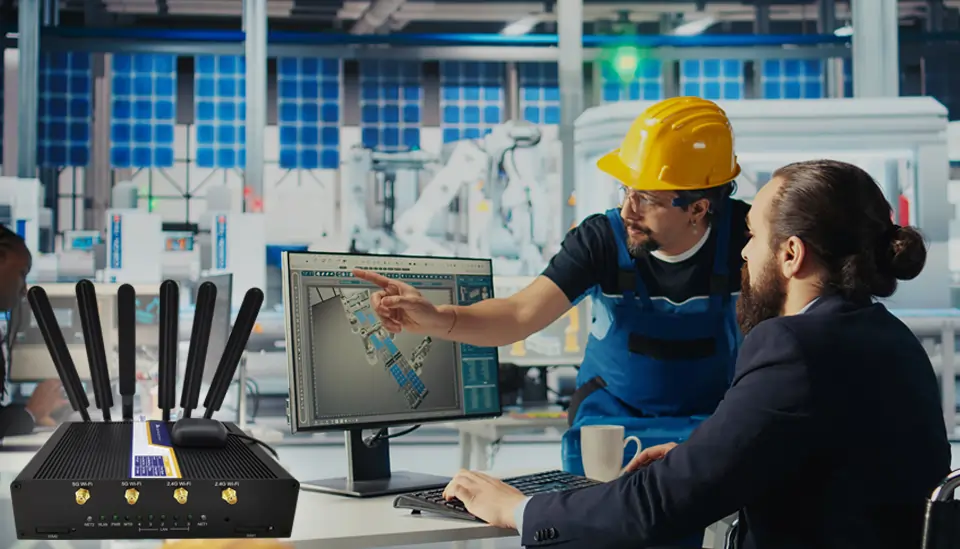
The transformation of grid monitoring & control
The energy sector is rapidly embracing smart grid technologies where all is digitally linked and remotely monitorable or controllable.
- Distributed Energy Resources (DERs) like solar panels, windmills, and batteries are also increasing the complexity of the grid.
- Utilities are providing more geography with more distributed points of control.
- Customers are requiring uptime and power quality as high as ever.
- Utilities will need low-latency, high-throughput connectivity to remotely connect control centers with remote devices like PLCs, SCADA terminals, and RTUs.
Why power utilities need rugged industrial connectivity solutions
Utility environments are not typical office networks. They consist of:
- Hard physical environments — temperature fluctuation, dust, vibration, and electromagnetic interference (EMI).
- Mission-critical networks — communication failure in them can lead to power downtime.
- Regulatory compliance — stringent cybersecurity requirements like NERC CIP demand encrypted, authenticated connections.
The industrial deployment rugged indoor LTE/5G gateway will have to be compliant and provide carrier-grade reliability.
Horizon IR2005G: A mission-critical network solution
Horizon IR2005G industrial router and not a modem for mission-critical deployment in high-usage deployments like power grid deployment, factories, and high-usage IoT networks.
Key Points:
- CBRS Band 48 private LTE/5G deployment support.
- downlink speeds of up to 3.4 Gbps on 5G.
- Dual SIM support to avoid carrier outages.
- Rugged metal design with EMI shielding and radiator panel for heat dissipation.
- Multiple mounting options — desktop, wall, or DIN-rail.
Its tough character renders it equally suitable for factory floor, warehouse, substation, or control room grid monitoring automation.
Key features that empower power utilities
Ultra-reliable connectivity
Downtime is never on the agenda when monitoring grids. The IR2005G offers ultra-speed 5G and LTE failover backup over Ethernet, cellular, and Wi-Fi connectivity. It offers glitch-free data transfer to remote monitoring sites and SCADA systems.
Industrial-grade reliability
Metal casing gives shielding against EMI from high-voltage equipment and contains a thermal design to support operation in extreme temperature environments.
Massive network support
Supports many 5G NR and LTE bands, including Band 48 for private networks on CBRS. Mission-critical control traffic can be prioritized by network administrators through configurable VLANs, QoS, and routing optimization.
Enhanced security & remote management
IPsec, OpenVPN, DMVPN, and firewall features built into the IR2005G make it highly secure to fulfill utility security needs. Horizon’s Device Management System (DMS) and TR-069 provide remote configuration, upgrade, and diagnostic capability – minimizing site calls and operation expenses.
Flexible I/O for industrial application
RS-232, RS-485, digital I/O, GPS, and USB interfaces provide straightforward interfacing with SCADA devices, programmable logic controllers, environmental sensors, and GPS-based location identifier systems.
Application situations in power utilities
Substation automation
Smart substations are the grid’s nervous system with voltage control ready to sniff out faults. The Horizon IR2005G allows online real-time monitoring and control of circuit breakers, transformers, protective relays, and environmental sensors. Without field devices and central controllers communicating directly with one another, operators pre-calculate faults, re-route the faulted areas, and return in a rush — all increasing reliability and shaving outage time big time.
Remote SCADA access
SCADA operations rely on low-latency, secure communications to operate at their best. IR2005G brings remote terminal units (RTUs), programmable logic controllers (PLCs), and SCADA central servers together with low-latency, secure communications on a dedicated LTE/5G backhaul. That is to say, utility operators are able to see real-time system information remotely, control operations remotely, and access alarms remotely without having to necessarily use insecure public networks.
Predictive maintenance & asset management
Equipment failures due to a fault can cause huge repair costs and downtime of the entire system. IR2005G, equipped with IoT sensors and analysis software integrated in it, enables predictive maintenance activities through real-time monitoring of the temperature, vibration, and loading condition of the equipment constantly. The utilities can use it to monitor anomalies whenever they happen, plan precision maintenance, and extend the life of the mission-critical assets.
Emergency response & disaster recovery
Disaster, construction loss, or accident can wipe out copper or fiber cable instantly with little notice. When such happens, the IR2005G will switch over automatically to LTE/5G connectivity, ensuring control system operation and communication with field personnel. This ensures utilities have real-time visibility from assets through utilities, schedule repairs in the field, and restore power quickly during peak demand.
Integration with renewable energy assets
With more and more renewable sources being taken online, the utilities are confronted with larger and larger aggregations of solar farms, windmills, and batteries that can be constructed outback or in the bush. IR2005G allows quick and secure transmission of such facilities to master positions so that real-time monitoring, performance monitoring, and grid integration are achieved in an integrated manner. It is therefore able to balance demand and supply against requirements for sustainability.
Private LTE and CBRS facilitate utility operations
CBRS Band 48 is best suited for utilities since it utilizes dedicated spectrum with wireless ease of deployment.
Benefits are:
- Security — network, less exposure to risk from public internet.
- Control — utilities maintain control of bandwidth and priority.
- Coverage — affordable access to remote-end substations with no fiber trenching.
- Scalability— easy to add new endpoints during expansion in the grid.
A 5G modem smart factory, like the IR2005G, just extends the same advantage to the power industry.
Power utility installation considerations
Site surveys & antenna siting
Proper antenna placement is necessary to perform best, especially where indoor CPE deployment is done within high-walled control panels or where EMI interference is present.
Best practices for network configuration
Use VLANs and QoS policies to mark SCADA and control commands as greater-priority traffic than any other traffic.
Security features
Leverage VPN encryption, strong authentication, and periodic firmware updates to deliver compliance.
ROI of industrial-class connectivity for utilities
In-building router hardware-hardened for CBRS deployment, such as the IR2005G, with measurable payback:
- Fewer Outages — faster fault correction and self-healing failover.
- Operational Cost Savings — truck roll and site visit avoidance through remote management.
- Increased Safety — more efficient fault detection and isolation.
- Future-Proofing — future-proofed for future smart grid rollouts and IoT connectivity.
Frequently asked questions (FAQs)
Q1. What is a CPE for CBRS, and how are utilities using it?
A CBRS CPE (Customer Premises Equipment) connects utility control systems to a reserved LTE/5G private network, with reserved bandwidth security.
Q2. Is Horizon IR2005G hardened for extreme environments?
Yes — metal case enclosure, EMI shielding, and thermal protection to survive hostile environments.
Q3. How does dual SIM failover improve uptime?
It roams automatically between carriers and is always online, even when one goes offline.
Q4. Why is Band 48 ideal for mission-critical use?
Band 48 offers reserved, interference-free spectrum for low-latency, high-reliability private LTE/5G networks.
Q5. Does IR2005G co-exist with legacy SCADA systems?
Yes — RS-232, RS-485, and Ethernet support make legacy equipment interfacing easier.
Q6. Is private LTE/5G transmission of private data secure?
Private networks and VPN encryption allow for utility-grade cybersecurity compliance.
Q7. Is it supported by renewable energy monitoring hardware?
Yes — solar, wind, and battery storage monitors are supported with private LTE/5G.
Q8. Which IR2005G control room mounting options are supported?
Desktop mount, wall-mount, and DIN-rail mount are supported.
Q9. How is remote management simplified on the Horizon DMS platform?
Remote installation, firmware upgrades, and diagnosis are centrally conducted.
Q10. What will utilities see in latency when operating with 5G CBRS?
Low latency of a few milliseconds, safely within tolerances for real-time control instructions.
Final thoughts
As the utilities start modernizing and consolidating their infrastructure into end-to-end integrated smart grid systems, high-speed, high-performance connectivity is no longer a nicety but a necessity. Distributed management of renewable resources, real-time fault detection, and remote operations all rely on the availability and quality of a utility’s communications infrastructure, with a direct impact on its operational efficiency, safety, and service continuity.
Horizon IR2005G — its rugged, 5G CBRS-ready industrial-grade security and durability — is not just a device connectivity issue. It’s an early platform for grid monitoring, automated control, predictive maintenance, and rapid emergency response. Its durability to withstand stressful industrial conditions allows utilities to keep running without any disruption, even under stressful high-interference or high-demand environments.
For operationally superior, safety-minded companies in the long term, purchasing a private LTE industrial router like the IR2005G is not technology step-keeping up; it’s an investment in a smarter, stronger, more connected energy system that will be able to meet the demands of tomorrow.
Learn more about Monitoring and Control for Power Utilities here.
Related Posts
Qualcomm X62 and 5G NR Capabilities: The Performance Driver of IR2005G
Increasing Remote Work Productivity with HZ51’s High-Speed Connectivity
Secure, Reliable, and Fast: What IR2005G Provides to Industrial Networks
Comparing HZ51 with Traditional Routers: A New Era of Internet Access
Dual SIM & Failover: Where IR2005G for Seamless Industrial Networking
Inside the Security Stack: VPN, IPSec, OpenVPN and Firewall IR2005G Features
From GPS to RS485: Flexing to the IR2005G’s Multiple I/O Interfaces
Transforming Home Entertainment with HZ51’s Ultra-Fast Speeds
Smart Homes Made Smarter: Integrating HZ51 for Optimal Performance
Ensuring Reliable Connectivity for Online Learning with HZ51
Bandwidth Control and VLANs: How IR2005G Maximizes Network Control